Leggi questo articolo in italiano →
At 06:20 on a June morning the Colosseum’s travertine turns from grey to apricot in four minutes; the only people on Via Nicola Salvi are two street sweepers and, if you booked early, the two of you. That is the Rome we photograph: the famous stone before the city wakes, and the side streets where the light stays good all day.
This guide covers the best photoshoot locations in Rome for couples — more than fifteen spots, from the postcards to streets most visitors never reach — with the hour we shoot each one, where the light comes from and how to dodge the crowds. Planning to propose? Read it with the best places to propose in Rome.
At a glance
- Top three: the Colosseum from Via Nicola Salvi at sunrise, the Giardino degli Aranci at golden hour, Ponte Sant’Angelo at blue hour.
- Best time: sunrise, all year (05:40 in June, 07:30 in December); April–June and September–October.
- Crowds and rules: Trevi has had crowd-management measures since 2025 — go 06:00–07:00 and check the current rules; no sitting on the Spanish Steps; Colosseum, Forum and Vatican interiors are ticketed.
- Who this suits: engagement, honeymoon and anniversary couples, surprise proposals, Flying Dress and Vespa shoots.
- Budget: 60-minute couple session from €380; surprise proposal package (90 min) from €490; 20–80 edited photos within 24 hours.
- Booking: sunrise and golden-hour slots go first — book 4–6 weeks ahead in peak season.
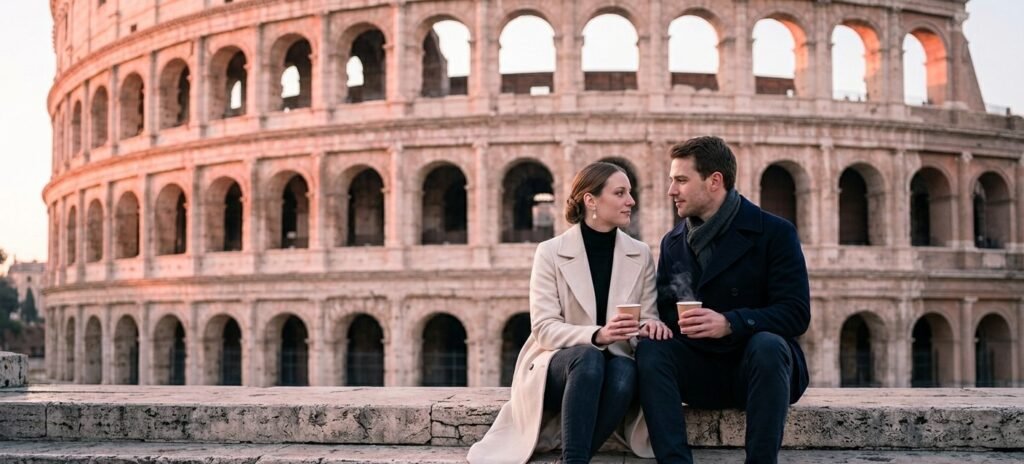
The Colosseum at dawn: the iconic photoshoot location in Rome for couples
Three free vantage points. The balustrade along Via Nicola Salvi gives a raised three-quarter view; Largo Gaetana Agnesi, above the metro exit, gives the frontal postcard; Colle Oppio park frames the arches between umbrella pines. In summer the sun rises roughly behind Largo Agnesi and lights the stone frontally. We start 25 minutes before sunrise and cover all three by 07:00; tour groups arrive around 08:30. Via Nicola Salvi’s wide steps are also where we shoot the Flying Dress, before finishing in Monti, five minutes away.
Best time: 30 minutes before sunrise to 45 after, any month. Photographer’s tip: step ten metres back from the balustrade and we use a longer lens — the Colosseum grows behind you.
Trevi Fountain at 06:00
The hour decides everything here: at 06:00 the piazza holds a handful of people; by 09:00 it is shoulder to shoulder. Since 2025 the city has limited access to the basin — check the current rules before you go. Tall buildings hem the square in, so dawn light is soft and the travertine reads white, not blown out.
Best time: 06:00–07:00, any season. Photographer’s tip: we shoot from the upper level on the Via della Stamperia side, then from Via delle Muratte, where the fountain appears at the end of the street.
Spanish Steps and Via Margutta
Sitting on the Spanish Steps is prohibited, so we pose you standing on the side flights or the landings, Trinità dei Monti above, the Barcaccia below. At 06:30 the steps are empty and shadowless; by 10:00 they belong to the crowds. Three minutes away, ivy covers whole façades on Via Margutta, the artists’ street — narrow, shaded all day, our fallback in harsh sun.
Best time: steps 06:15–07:30; Via Margutta until late morning and after 17:00. Photographer’s tip: burgundy, forest green and navy sit beautifully against the ivy; white gets lost.
Pincio Terrace and Villa Borghese lake
The Pincio terrace, Piazzale Napoleone I, faces west over Piazza del Popolo toward St Peter’s dome, so sunset light comes straight at you, warm and low. It fills 30 minutes before sunset, so we arrive an hour early, shoot the balustrade, then retreat among the pines. Ten minutes into Villa Borghese, rowing boats circle the Temple of Asclepius on the lake — a cliché that still works.
Best time: the last hour before sunset (20:45 in June, 16:40 in December). Photographer’s tip: boat first, terrace last — be at the balustrade as the sun touches the horizon.
Giardino degli Aranci and the Aventine keyhole
The Aventine is the quiet hill. The Giardino degli Aranci (Parco Savello) has a terrace facing west over the Tiber to St Peter’s dome, orange trees and a stone gateway; it opens early and closes at dusk, hours varying by season. Two minutes on, at Piazza dei Cavalieri di Malta, the keyhole frames the dome down a hedge-lined avenue; Piranesi’s stelae deserve a frame of their own.
Best time: the last 90 minutes before sunset, or spring, when the Roseto Comunale below is in bloom. Photographer’s tip: the keyhole shot is a phone-to-the-hole trick; the portrait we want is you in the gateway, dome behind.
Campidoglio and the Forum overlook
Climb Michelangelo’s cordonata to his star-patterned piazza, Marcus Aurelius at the centre — lit at night, rarely busy. Then take Via del Campidoglio or Via di Monte Tarpeo, either side of Palazzo Senatorio: both lead to a balcony over the Roman Forum, Arch of Septimius Severus below, Colosseum beyond. The overlook faces east-south-east: backlit and misty at sunrise, warm side light late in the day, floodlit after dark.
Best time: the hour before sunset, then the floodlit Forum from Via dei Fori Imperiali. Photographer’s tip: from the steps of Palazzo Senatorio we shoot down onto the star, you at its centre.
Ponte Sant’Angelo at blue hour
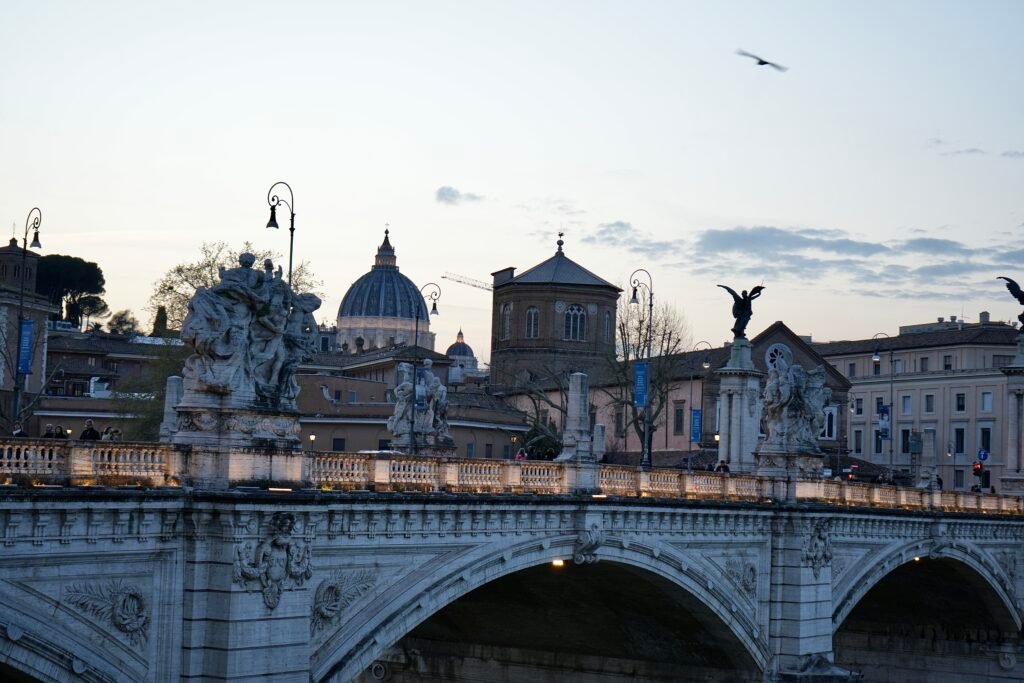
Bernini’s angels line the bridge, Castel Sant’Angelo closes one end and St Peter’s dome closes the horizon to the west. The full postcard — dome, castle, bridge, river — is taken from Ponte Umberto I, the next bridge upstream; we do both in 40 minutes. Blue hour is the point: 15–35 minutes after sunset the dome lights up while the sky is still deep blue and the river holds the reflections.
Best time: sunset to 40 minutes after, any season; in winter that is a civilised 17:00. Photographer’s tip: stand at the castle end, angels behind you — a long lens puts the dome over your shoulder.
Piazza Navona and Via dei Coronari
Piazza Navona at 07:00 is another place: no café terraces yet, nobody on the rim of the Fountain of the Four Rivers, the long oval yours. High walls keep direct sun out until mid-morning, so Sant’Agnese glows rather than glares. Leave from the north end into Via dei Coronari, the antique dealers’ street: it runs almost east–west, so low sun rakes down it early and late, past ochre and rose façades — the centre’s best colour backdrop.
Best time: 06:45–08:30 for the piazza; Via dei Coronari also at golden hour. Photographer’s tip: you walk toward us down Via dei Coronari from 30 metres — the perspective does the composing.
Campo de’ Fiori, Arco degli Acetari and Via Giulia
Campo de’ Fiori’s market runs Monday to Saturday mornings under Giordano Bruno’s statue; we work the edges, ranunculus as a prop, you between the awnings. A minute away, at Via del Pellegrino 19, an unmarked passage opens into the Arco degli Acetari, a medieval courtyard of ochre plaster and external stairs; people live here, so we are quiet and gone in ten minutes. Then behind Palazzo Farnese is Via Giulia, with the ivy-draped Arco Farnese and the Fontana del Mascherone, shaded most of the day.
Best time: 08:00–10:00 for the market; courtyard and Via Giulia any hour. Photographer’s tip: the Acetari’s ochre is warm, so cool tones — sage, dusty blue — separate you from the wall.
Trastevere and the Gianicolo
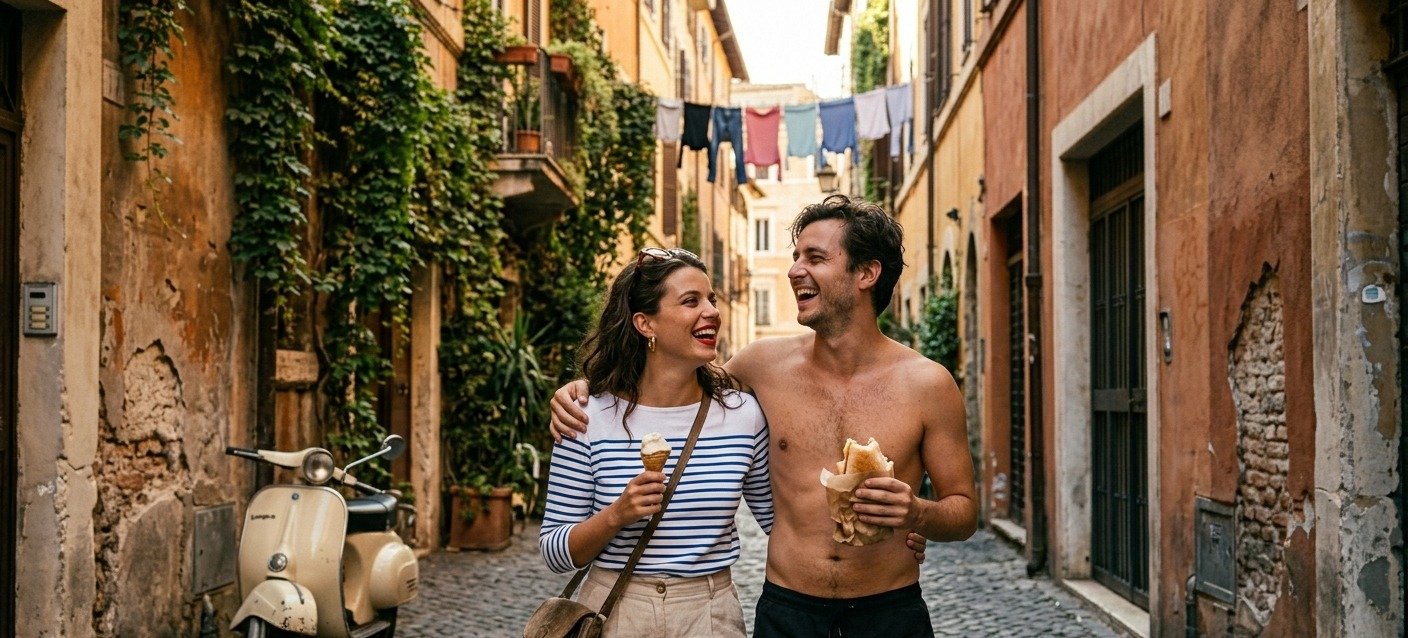
Trastevere is ivy, laundry and ochre. Our loop: Vicolo del Cinque, Via della Scala, Vicolo del Cedro, then Piazza di Santa Maria in Trastevere, where the medieval mosaics on the façade catch the morning sun. Lanes are empty before 09:00, full for aperitivo after 19:00. Fifteen minutes uphill, the Gianicolo terrace faces east over the whole city, a sunrise panorama; below it, the Fontanone is lit at night and empty by 21:00.
Best time: Trastevere 07:30–09:30; the Gianicolo at sunrise, or after dark for the Fontanone. Photographer’s tip: at the Fontanone we shoot from across the road with a long lens; the whole lit façade frames you.
Quartiere Coppedè: the secret one
Gino Coppedè’s district (1915–1927), around Piazza Mincio, looks like nothing else in Rome: Art Nouveau crossed with medieval and Baroque, frogs on the fountain, fairy-tale turrets. Enter under the great arch from Via Tagliamento, wrought-iron chandelier overhead, and you reach the Fontana delle Rane and the Villino delle Fate. Residential and small — three or four spots within two streets — it is a 30-minute add-on. Tram 3 or 19 to Piazza Buenos Aires.
Best time: Sunday 08:00–10:00, when it is empty; one façade is always lit. Photographer’s tip: stand under the arch — chandelier above you, piazza glowing beyond.
EUR: Palazzo della Civiltà Italiana
For a modern, editorial look, take Metro B to EUR Magliana. The “Square Colosseum” — six rows of nine travertine arches — is the most graphic backdrop in the city: wide steps, a lawn, almost no tourists; the interior is private, the exterior accessible. Golden hour warms the travertine; midday throws deep shadows into the arches — good for black and white. EUR’s wide, straight avenues are also where a classic-car shoot makes most sense — no cobblestones, no crowds.
Best time: the last hour before sunset; Sunday mornings for empty steps. Photographer’s tip: stand at the foot of the steps; we shoot across the lawn with a long lens so the arches fill the frame.
How a surprise proposal works here with us
Most of our Rome proposals happen at the Giardino degli Aranci at golden hour, the Colosseum at sunrise or Ponte Sant’Angelo at blue hour. A few days before, we scout the exact spot for the light and send you a WhatsApp pin with a photo of where to stand. You build the cover story — a sunrise walk, a “guided tour”, a table booked nearby — and we agree a signal, usually a text five minutes out.
We are already in position 20–40 metres away with a long lens. We capture the kneel, the “yes” and the first thirty seconds nobody remembers, then step in for 45–60 minutes of portraits. The full gallery arrives within 24 hours, the key frame within hours. See the surprise proposal experience.
Practical notes
- Getting around: the centre is walkable; Metro B and taxis cover the rest. Much of it is a limited-traffic zone (ZTL), so we plan car and Vespa photoshoot routes around it.
- Crowds: 06:00–08:00 nearly empty; 10:00–18:00 Trevi, Spanish Steps and Colosseum packed; after sunset bridges and Trastevere lively but workable.
- Seasons: April–June and September–October are ideal; July–August bring heat and a 05:40 sunrise; December–February, empty piazzas, soft light and a 16:45 sunset.
- Tickets: Colosseum, Forum, Vatican Museums and Terme di Caracalla interiors are ticketed and not shoot-friendly; we photograph them from outside.
- Weather: if it rains we reschedule free or shoot atmospheric frames — wet sampietrini reflect the lights.
- What to wear: long fabrics with movement, warm tones against the stone, no logos; flats for cobblestones, a layer for dawn. See what to wear for a photoshoot in Italy.
Frequently asked questions
Do we need a permit for a couples photoshoot in Rome?
For a walking couple session in public streets and piazzas we work handheld, with no tripod or lighting stands, and we have never needed a permit for that. Ticketed monuments are different: the Colosseum interior, the Roman Forum, the Vatican Museums and the Terme di Caracalla require a ticket and apply their own photography rules, so we shoot them from outside. Rules change, so check the current ones before you go.
Is sunrise or sunset better for couple photos in Rome?
Sunrise, in most cases. At 06:00 the Colosseum, Trevi Fountain, Spanish Steps and Piazza Navona are nearly empty and the light is soft; by 10:00 they are packed. Sunset is the better choice for west-facing viewpoints such as the Pincio and the Giardino degli Aranci, and blue hour is unbeatable at Ponte Sant'Angelo. In summer sunrise is about 05:40, in December about 07:30.
How much does a couples photoshoot in Rome cost?
Our standard Rome couple session is 60 minutes from €380, with 20 to 80 edited photos delivered within 24 hours through an online gallery. The surprise proposal package is 90 minutes from €490 and includes discreet positioning, the moment of the yes, a portrait session afterwards and an express edit of the key frame within hours. Longer sessions covering several neighbourhoods are quoted on request.
Can we still take photos at the Trevi Fountain with the new crowd rules?
Yes. Since 2025 the city has limited how many people can stand at the basin at once, with controlled access at busy times. It changes little at dawn: between 06:00 and 07:00 the piazza holds only a handful of people, and we also shoot from the upper level and from Via delle Muratte, where the fountain appears at the end of the street. Check the current rules before you go.
How many locations can we cover in one photoshoot in Rome?
A 60-minute session comfortably covers one area with two or three spots: the Colosseum with Monti, or Piazza Navona with Via dei Coronari and Ponte Sant'Angelo. To combine the Aventine with Trastevere, or the historic centre with the Campidoglio, allow 90 to 120 minutes. For spread-out routes a Vespa or classic-car shoot moves you between spots without wasting light.
couples photoshoot · engagement photos · golden hour · photo locations · photo spots · rome
Planning a proposal or a couples shoot in Italy? Let us frame it.
Tell us the city and the date. We reply within a few hours with availability, the best light window and a quote.