Leggi questo articolo in italiano →
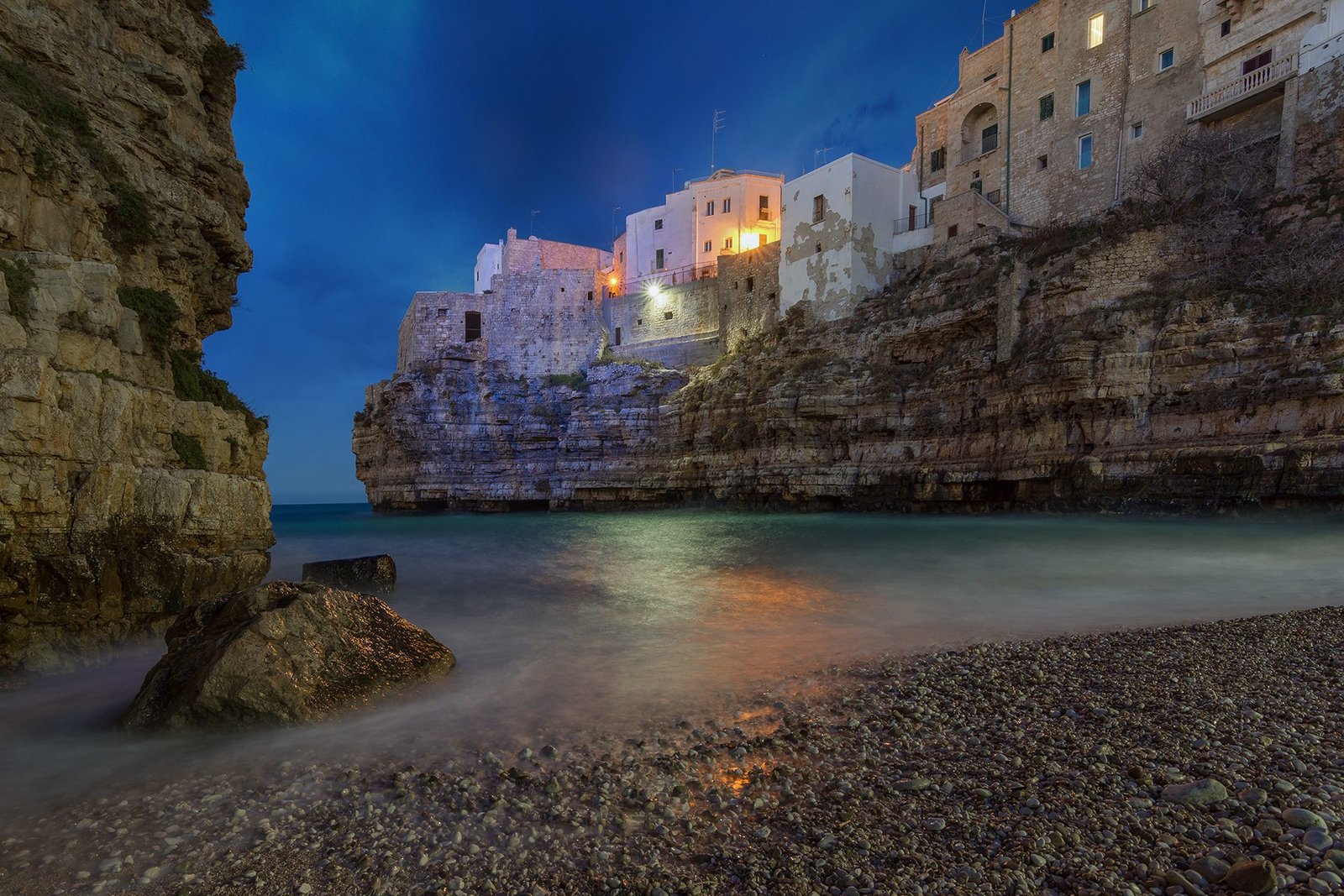
Just before 05:30 on a June morning the sun comes up out of the Adriatic in front of Polignano a Mare, and for twenty minutes the cliffs of Lama Monachile turn from grey to apricot while the town above is still asleep. Puglia rewards early risers: almost everything worth photographing here is pale stone, and pale stone holds warm light like nothing else.
This Puglia photoshoot and proposal guide comes from our scouting notes for Polignano a Mare, Alberobello, Ostuni, the Valle d’Itria, Lecce, the Salento coast and Matera as a bonus: for each spot, the angle, the hour and the logistics for a surprise proposal or a couples photoshoot.
At a glance
- Top three spots: Lama Monachile at sunrise, Rione Monti in Alberobello before 08:00, Ostuni’s white lanes in the last hour of light.
- Best months: May–June and September; July and August mean 35 °C afternoons, harsh light and Ferragosto crowds.
- Permits and crowds: streets and belvederes are free to photograph; masserie, Trullo Sovrano and Grotta della Poesia have rules or tickets, so check before you go.
- Who this suits: couples road-tripping the Valle d’Itria, honeymooners at a masseria.
- Budget and booking: custom quote with travel included, 20–80 edited photos within 24 hours; book 4–6 weeks ahead in peak season. See all our destinations.
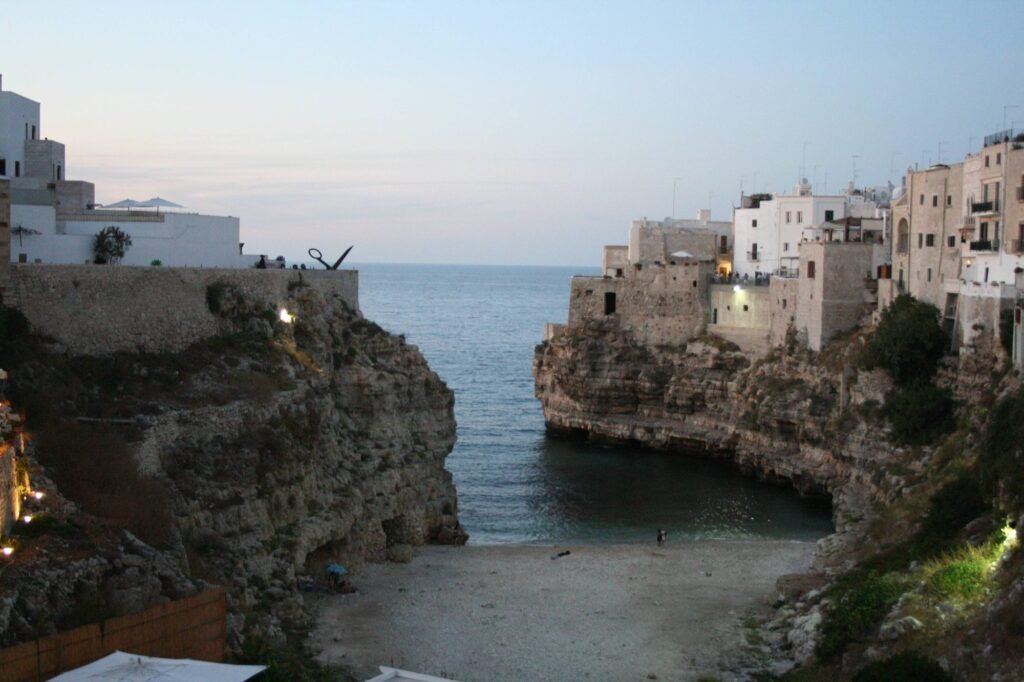
Polignano a Mare: Lama Monachile, the Ponte Borbonico and Terrazza Santo Stefano
Lama Monachile is the pebble cove on every Puglia postcard: a slot between two limestone cliffs, water that turns turquoise once the sun clears the horizon. The classic frame is from the Ponte Borbonico, the old bridge over the ravine; from mid-parapet a 35 mm lens takes in both cliffs and the sea. The cove opens north-east, so it is lit from sunrise to late morning and covered in towels from 10:00 in summer. Through the Arco Marchesale, the old town adds Largo Ardito, a terrace looking back over the cove to the bridge, and Terrazza Santo Stefano, hanging over open sea.
Best time: the first 90 minutes after sunrise (05:20 in June, 06:30 in late September). Photographer’s tip: propose on the bridge, not the pebbles; it says Polignano in one frame, and we can shoot it from Largo Ardito unnoticed.
Alberobello: Rione Monti at dawn, Rione Aia Piccola for quiet
Rione Monti is the hillside of more than a thousand trulli that earned Alberobello its UNESCO listing. At 06:30 it is a silent village of white cones and grey stone roofs; by 10:00 Via Monte San Michele and Via Monte Pertica are lined with open shops and tour groups, so we only shoot it early. Start at Belvedere Santa Lucia for the wide, layered view, then climb Via Monte Pertica to the trullo-shaped Chiesa di Sant’Antonio and work back down the side lanes. Across Largo Martellotta, Rione Aia Piccola is where people still live in their trulli: around four hundred, no shops, quiet even at 11:00 in July.
Best time: 05:30–07:30 in June, 06:30–08:30 in September, when low sun skims the whitewash. Photographer’s tip: the lane in front of Sant’Antonio is a clear proposal stage, cones falling away behind you; in rain the wet limestone turns silver.
Ostuni at sunset: the white city for a Puglia photoshoot
Ostuni sits on a hill 8 km from the coast, its old town a heap of whitewashed houses that reads as one bright shape from the olive groves below. The long view, from the country lanes among ancient olives below town, where whitewash picks up whatever colour the sky has and turns pale gold in the last hour. And the inside: Via Cattedrale climbing to the 15th-century cathedral with its rose window and the Arco Scoppa beside it, whitewashed stairways and arches at every turn, and Piazza della Libertà with the baroque spire of Sant’Oronzo.
Best time: the 90 minutes before sunset; white stone bounces light everywhere, so faces stay soft even in August. Photographer’s tip: white on white works here; our guide on what to wear for an engagement or proposal shoot in Italy has palettes by destination.
Locorotondo and Cisternino: Valle d’Itria lanes
Twenty minutes from Alberobello, Locorotondo is a ring of white houses on a hilltop, named for its circular plan. Its signature is the cummerse, steep limestone-slab roofs. Via Nardelli, the panoramic walk along the edge of the old town, looks over the whole Valle d’Itria; inside the ring the lanes are stacked with flowerpots and shaded until late morning. Cisternino, ten minutes on, is rougher and warmer: the Torre Normanno-Sveva beside the Chiesa Matrice, outdoor staircases, butchers grilling bombette on the pavement from early evening.
Best time: Locorotondo in the two hours after sunrise; Cisternino from 19:00 in summer, when the grills light. Photographer’s tip: Locorotondo’s lanes are the best place in Puglia to shoot at midday; the white walls act as one giant softbox.
A masseria and its ancient olive trees
Puglia’s fortified farmhouses, the masserie, are where most couples we photograph here actually sleep, and the easiest place for a private proposal: whitewashed courtyards, dry-stone walls, a pool among the trees and, in the Piana degli Ulivi Monumentali between Monopoli, Fasano and Ostuni, olive trees with twisted trunks that are centuries old. Shooting is always by arrangement with the owners, and some charge a location fee or reserve the grounds for guests. If you are staying, tell reception you are planning a proposal; most will keep a terrace clear.
Best time: the last hour before sunset among the olives, then the courtyard at blue hour. Photographer’s tip: ask us about a two-part session, golden hour at your masseria and sunrise in Polignano or Alberobello the next morning.
Monopoli: the old port and Cala Porta Vecchia
Fifteen minutes down the coast from Polignano, Monopoli is quieter and has the better working harbour. The Porto Antico is a small basin of blue and red wooden gozzi framed by the sixteenth-century Castello di Carlo V and pale houses; by 08:30 in summer the light on the water is already hard, so we come at first light. Around the corner, Cala Porta Vecchia is a pocket beach directly beneath the old walls: a private cove at 06:30, towels edge to edge by 10:00. Behind it, whitewashed lanes and a walk along the bastions.
Best time: sunrise at the port and the cove; this coast faces east, so both take the first light straight on. Photographer’s tip: from the bastion walk we shoot down into the harbour with a long lens, covering a proposal on the quay without standing on it.
Lecce: baroque in Piazza del Duomo
Lecce is 40 minutes south of Brindisi and built almost entirely of pietra leccese, a soft honey-coloured limestone. Piazza del Duomo is the set piece: a closed square entered through a single opening from Via Vittorio Emanuele II, with the cathedral, its tall campanile, the bishop’s palace and the seminary sealing the other sides. Two streets away, the façade of the Basilica di Santa Croce is the carved riot everyone photographs; the pavement is narrow, so we shoot from across Via Umberto I with a longer lens. Church interiors are for visiting, not shooting.
Best time: 07:30 in Piazza del Duomo, when the stone is pale gold and the square is yours; late afternoon on Santa Croce, when low sun rakes the carving. Photographer’s tip: pietra leccese photographs warmer than it looks, so skip orange and mustard; cream, navy and deep green sit best.
Otranto and the Torre Sant’Andrea sea stacks
Otranto is the easternmost town in Italy, which means the country’s first sunrise: at the Punta Palascìa lighthouse just south, the sun comes out of the sea a little after 05:15 in mid-June. The town is a small whitewashed maze inside bastioned walls, with the Castello Aragonese and a turquoise harbour. North of Otranto, on the Melendugno coast, the flat limestone ledges facing the Torre Sant’Andrea sea stacks are the stage for a proposal with the rock arches behind. Grotta della Poesia at nearby Roca Vecchia has restricted, ticketed access in summer; check the current rules before you go.
Best time: sunrise at Torre Sant’Andrea, since the stacks face east and are backlit by afternoon; Otranto’s walls at golden hour. Photographer’s tip: the ledges are sharp limestone, so walk down in proper shoes and change into heels only for the frames.
Nearby bonus: Matera and the Belvedere di Murgia Timone
Matera is in Basilicata, not Puglia, but it is an hour’s drive from Alberobello. The Sassi, two districts of cave houses carved into the flank of a ravine, are the most cinematic backdrop in southern Italy. The best view is from across the gorge: the Belvedere di Murgia Timone in the Parco della Murgia Materana, reached by car or on foot over the suspended footbridge across the Gravina. Inside the Sassi, Piazzetta Pascoli looks over Sasso Caveoso and the rock church of Santa Maria di Idris; everything is stairs, so carry flats.
Best time: sunrise at Murgia Timone, when the sun rises behind you and lights the Sassi straight on; at dusk the city turns to silhouette. Photographer’s tip: the belvedere at 06:30 in May is almost always empty, and a 200 mm lens from 30 m makes the whole city your background.
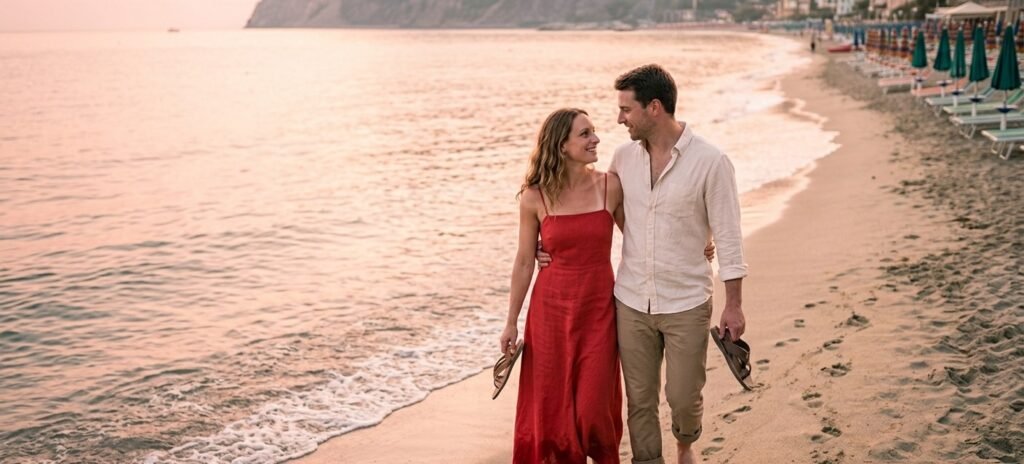
How a surprise proposal works here with us
Puglia proposals almost always begin with a WhatsApp message and a screenshot of a map. We help you pick the spot around the light and your route (the Ponte Borbonico at sunrise, the Sant’Antonio lane in Alberobello, your masseria’s olive grove) and scout it the evening before to fix the exact position. You get a pin and a simple cover story: an early walk to beat the heat, a sunrise coffee.
We wait 20–40 metres away with a long lens. You give the agreed signal, ask, and we cover the moment as it happens; then you have 45–60 minutes of relaxed portraits while the light holds. The express edit of the key frame arrives within hours, the full gallery within 24 hours. Details are on our surprise proposal experience page and in our guide to planning a surprise proposal in Italy.
Practical notes
- Getting there: fly to Bari for Polignano (about 40 minutes) and Alberobello (an hour), or Brindisi for Ostuni (35 minutes) and Lecce (40). You need a car; old-town ZTL zones mean parking outside the walls.
- Crowds by hour: old towns are empty until about 09:00, busy 10:00–13:00, deserted in the afternoon heat, busy again from 18:00. Sunrise beats everything.
- Light: sunrise is about 05:20 in mid-June, 06:35 in late September (approximate); compare seasons in our guide to the best time to propose in Italy.
- Permits, tickets and weather: masserie by arrangement; Trullo Sovrano and some churches ticketed; Grotta della Poesia regulated; check the current rules. Summer is reliably dry; if rain settles in, we reschedule for free or shoot the wet-stone version.
- Footwear and kit: whitewashed steps are slippery when wet, Matera is all stairs and the sea ledges are sharp: flats for walking, heels for the frames. Bring water, a layer for dawn and a hanger for the dress; coastal wind is constant, so pin hair or let it move.
Puglia is a region of white walls, and every lane is a reflector: that is why faces here stay soft even when the sun is anything but.
Frequently asked questions
Where is the best place to propose in Puglia?
For a single iconic frame, the Ponte Borbonico over Lama Monachile in Polignano a Mare at sunrise is hard to beat: sea, cliffs and old town in one view, and empty before 07:00. For privacy, the lane in front of the Chiesa di Sant’Antonio in Alberobello at dawn or an olive grove at your masseria at golden hour work just as well and need no negotiating with crowds.
Is sunrise or sunset better for a photoshoot in Polignano a Mare?
Sunrise, clearly. Polignano’s coast faces north-east, so Lama Monachile and the old-town terraces take the first light straight on and the beach is empty until about 09:00. By sunset the cove is in shade and full of people, though the lanes and the clock-tower square are lovely at blue hour when the lamps come on.
Do I need a permit for a photoshoot in Alberobello?
No permit is needed to photograph in the public lanes of Rione Monti and Aia Piccola; they are ordinary streets. Trullo Sovrano is a ticketed museum, and trulli interiors or private courtyards require the owner’s consent. Commercial shoots with lighting or closed lanes are a different matter; for a couples or proposal session we simply arrive early and keep doorways clear. Check the current rules before you go.
How much does a proposal photographer cost in Puglia?
Puglia is a travel destination for us, so we quote each session individually with travel included: send us your dates, town and rough plan on WhatsApp and you get a fixed figure. For reference, our Rome surprise proposal package is 90 minutes from €490 and a 60-minute couples session starts from €380. Every session delivers 20–80 edited photos within 24 hours.
Which month is best for a Puglia photoshoot?
Late May to June and September. You get 25 °C days, green countryside or a warm sea, sunrise between about 05:20 and 06:30 and far fewer people than in high summer. July and August bring 35 °C afternoons, harsh midday light and Ferragosto crowds, so then we shoot only at sunrise and in the last hour of light. Book 4–6 weeks ahead in peak season.
alberobello · ostuni · photo spots · polignano a mare · proposal · puglia
Planning a proposal or a couples shoot in Italy? Let us frame it.
Tell us the city and the date. We reply within a few hours with availability, the best light window and a quote.