Leggi questo articolo in italiano →
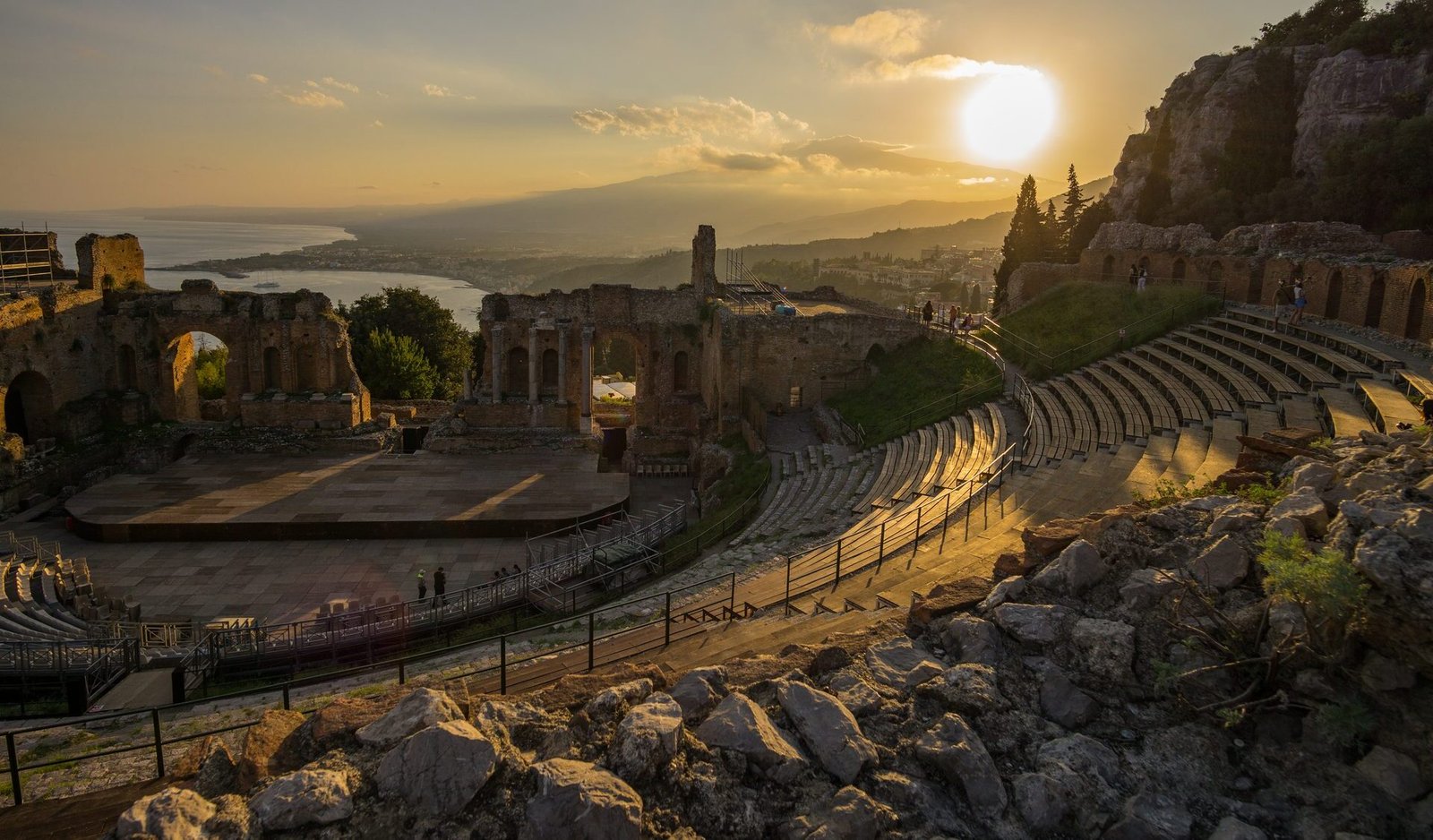
At 06:30 on a May morning the limestone of Piazza Duomo in Ortigia is turning from grey to cream, and the only sound is a café rolling up its shutter. Two hours north, first light is already on the summit of Etna behind the Teatro Antico di Taormina. Sicily gives you two kinds of light in one day: soft sea dawns on the Ionian side, and long warm evenings on baroque stone that holds its colour after sunset.
This guide covers the best places to propose in Sicily and the spots we scout for couples photoshoots: Taormina, Ortigia, Noto, Ragusa Ibla, Agrigento and Cefalù, with vantage point, light direction, crowd timing and ticket notes for each. Sicily is one of the destinations we quote individually, travel from Rome included.
At a glance
- Top three spots: Piazza Duomo in Ortigia at dawn, the Teatro Antico di Taormina with Etna behind the stage, Noto’s cathedral steps in the last hour of light.
- Best months: late April to June and mid-September to October. July and August mean 35 °C afternoons, so we shoot at sunrise.
- Tickets and permits: the Teatro Antico, the Valley of the Temples and the Isola Bella reserve are ticketed; shoots inside archaeological sites need authorisation; Scala dei Turchi access is restricted. Check the current rules before you go.
- Crowds: Taormina’s Corso Umberto is packed from 10:00 to 19:00 in season; Ortigia, Noto and Ragusa Ibla are quiet before 08:30.
- Who this suits: couples who want sea, baroque towns and a volcano in one trip, with a hire car.
- Budget: Sicily is a custom quote with travel included; for reference, our Rome surprise proposal package is 90 minutes from €490. 20–80 edited photos within 24 hours.
Teatro Antico di Taormina: Etna framed by the stage
The Greek theatre is why most couples come to Taormina: through the broken brick arches of the stage wall you see the Ionian coast and, on a clear morning, the whole cone of Etna. Entry is ticketed. Go at opening, before the coach groups arrive around 10:30, and climb to the upper tiers.
A quiet proposal between the two of you is fine as visitors. A photographer working inside with professional gear needs authorisation from the archaeological park, and we handle the request; check the current rules before you go.
Best time: opening hour in spring and autumn, when Etna is sharpest; by early afternoon the summit usually pulls in cloud. Photographer’s tip: from the top tier, 35 mm fits arches, sea and volcano together.
Piazza IX Aprile, the Villa Comunale and Castelmola
Piazza IX Aprile is Taormina’s terrace: black-and-white chequerboard paving, the clock tower of Porta di Mezzo and a railing that drops straight to the sea. Taormina faces east over the Ionian, so the terrace gets sunrise and clean morning light; by late afternoon the town sits in the shadow of Monte Tauro, soft for portraits but with no golden hour on the water.
Five minutes down Via Bagnoli Croci, the Villa Comunale gardens are free, terraced and far quieter, with brick follies framing Etna. For a sunset proposal take the bus up to Castelmola: its small piazza holds the light after Taormina has gone dark.
Best time: 07:00–08:30 for an empty piazza; Castelmola for the last hour of sun. Photographer’s tip: shoot low across the chequerboard toward the clock tower so the pattern leads the eye to you.
Isola Bella
The pearl-shaped islet below Taormina, joined to the pebble beach by a strip of stones the sea sometimes covers, is the coast’s most photographed view. The classic frame is from above: the belvedere on Via Pirandello, or the terrace by the cable-car station at Mazzarò.
Isola Bella is a nature reserve; walking onto the island itself is ticketed and access can change, so check before you go. The beach is pebbles: bring sandals and change into heels for the portraits. Our guide on what to wear for a proposal shoot in Italy covers footwear and colours.
Best time: the bay faces east, so sunrise to about 10:00 gives lit water and empty pebbles. Photographer’s tip: from the belvedere, light cloud makes the water bluer and stops the pebbles blowing out.
Piazza Duomo, Ortigia: the best place to propose in Sicily at dawn
Ortigia is the island heart of Syracuse and Piazza Duomo its centrepiece: a long, curving space of pale limestone closed by the cathedral, built around the Doric columns of a Greek temple still visible on Via Minerva, Palazzo Beneventano del Bosco and Santa Lucia alla Badia.
The cathedral façade faces west. At dawn it stands in shade against a bright sky and the piazza is empty; from about 16:00 in spring the façade takes direct warm light. For a proposal we prefer dawn: nobody else in frame.
Best time: 06:15–07:30 from April to June; late afternoon for the lit façade. Photographer’s tip: stand your partner on the axis of the cathedral steps and shoot from the far side of the piazza at 85 mm.
Fonte Aretusa and the Lungomare di Levante, Ortigia
Sunrise belongs to the east side: the Lungomare di Levante runs along the old ramparts from Forte Vigliena toward the tip of the island, with nothing between you and the sun coming out of the Ionian. Locals swim off the rocks here at 07:00.
Sunset belongs to the west: the Fonte Aretusa, a freshwater spring with papyrus and ducks a few metres from the sea, and the Passeggio Adorno above it, looking over the Porto Grande. The light comes straight across the harbour.
Best time: Lungomare di Levante 20 minutes before sunrise; Fonte Aretusa the last hour of light. Photographer’s tip: at Aretusa we shoot from the upper railing down through the papyrus, then turn you toward the harbour for backlit portraits.
Noto: Corso Vittorio Emanuele and the cathedral steps
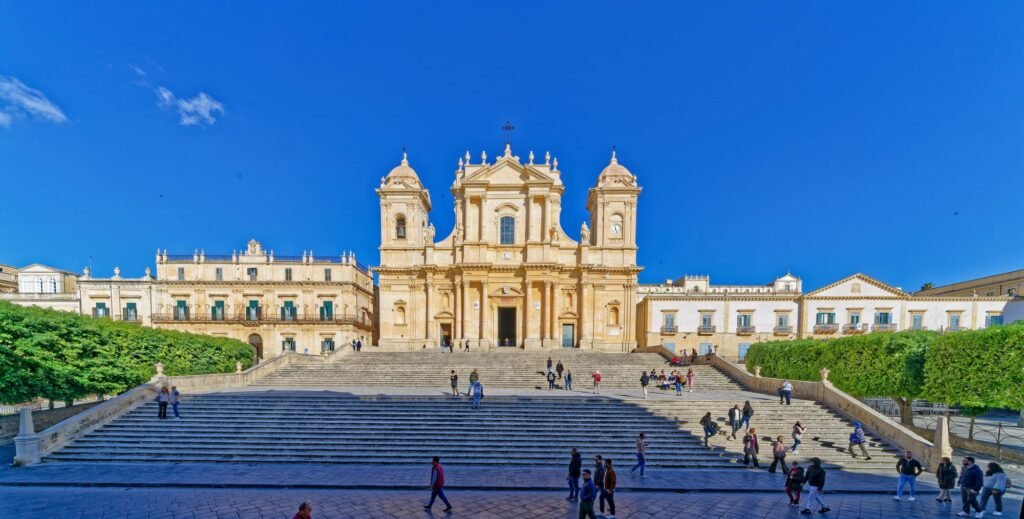
Noto was rebuilt after the 1693 earthquake in a single burst of baroque, and the whole Corso Vittorio Emanuele is cut from the same honey-coloured limestone. The cathedral of San Nicolò tops a broad flight of steps with Palazzo Ducezio opposite; the façade faces south and glows in the last hour.
Turn up Via Nicolaci for the carved balconies of Palazzo Nicolaci, and come in mid-May if you can, when the Infiorata carpets the street in petals. The steps are public and very visible, so a proposal here suits couples who enjoy an audience.
Best time: 07:30–09:00 for empty steps, or the hour before sunset when the stone turns orange. Photographer’s tip: we frame from halfway up the Palazzo Ducezio steps, so the full façade sits behind you without tilting the lens.
Ragusa Ibla, seen from Santa Maria delle Scale
Ragusa has two towns: the upper, modern one and Ibla, the baroque old quarter on its own hill. The terrace beside the church of Santa Maria delle Scale, at the top of the stairs that link them, gives the postcard: a heap of stone houses with the dome of San Giorgio rising out of it. Then walk the 300-odd steps down into Ibla, to the sloping Piazza Duomo and the Giardino Ibleo at the far end, a public garden over the valley. At 08:00, even in June, the piazza is close to empty.
Best time: the terrace faces east toward Ibla, so the last hour of sun lights the town from behind you. Photographer’s tip: propose in the Giardino Ibleo, then walk back up for the skyline portraits; wear shoes that can manage the steps.
Agrigento: Valley of the Temples and Scala dei Turchi
The Temple of Concordia is one of the best-preserved Greek temples anywhere, on a ridge with the Temple of Juno at one end, the Temple of Heracles at the other and almond and olive trees between. The park is ticketed. Professional shoots need authorisation, and the floodlit summer evening openings change from year to year, so check the current rules before you go.
Twenty minutes away, the white marl cliff of Scala dei Turchi steps down to the sea in rounded terraces that photograph like snow. Climbing on it has been restricted in recent years and the rules keep changing; check before you go, and plan to shoot from the beach beside it, which still gives you the whole white wall.
Best time: the last two hours before the park closes, when the west sun turns the sandstone gold; the hour before sunset at the Scala. Photographer’s tip: white clothing disappears against the marl, so wear colour there; rust or cobalt reads from 200 metres.
Cefalù
Cefalù is the northern coast’s answer to Taormina, an hour by train from Palermo: a crescent of sand, a row of fishermen’s houses standing in the water and the Norman cathedral of 1131 in front of the great rock of La Rocca. The classic view is from the western end of the beach, looking back along the seafront to the old town. In the lanes, Porta Pescara frames the sea and the medieval Lavatoio gives cool, quiet close portraits. The seafront houses face north-west, so this is a sunset town in a way the Ionian side is not.
Best time: the hour before sunset from the beach; Piazza del Duomo at 08:00. Photographer’s tip: we time the “yes” for the moment the low sun lights the houses along the water, then move into the lanes for blue hour.
Sicilian limestone is the most forgiving surface we shoot on: in Noto and Ortigia the whole street works as a reflector, so faces stay soft even an hour after sunrise.
How a surprise proposal works here with us
We scout the exact spot the day before or at first light: which step in Noto, which stretch of the Lungomare in Ortigia, where the sun will be at the minute you plan to kneel. You get a cover story that fits the place, a “sunrise walk before breakfast”, plus a WhatsApp pin for the precise standing point and a simple signal, usually you setting down a bag.
We are 20–40 metres away with a long lens, dressed like tourists. You ask, they answer, and we keep shooting through the tears. A relaxed 45–60 minute portrait session follows in the same light, and the gallery arrives within 24 hours, with an express edit of the “yes” frame within hours. The full outline is on our surprise proposal experience page; our step-by-step planning guide covers the rest.
Practical notes
- Getting there: fly to Catania for Taormina (about 50 minutes by car), Ortigia, Noto and Ragusa; fly to Palermo for Cefalù. Agrigento is roughly two hours from either.
- Driving: a hire car is the only practical way to link the baroque towns. Taormina’s centre is a restricted traffic zone; park at Lumbi or Porta Catania and walk.
- Seasons: April–June and September–October for light and temperatures; July–August for dawn only. Our guide to the best time to propose in Italy goes month by month.
- Weather: a scirocco day brings haze and 35 °C; if rain comes we reschedule for free or shoot the wet baroque stone.
- What to bring: flats for Ragusa’s steps, heels in a bag for portraits, a light layer for dawn, water.
Frequently asked questions
Do I need a permit to propose at the Teatro Antico di Taormina?
The theatre is a ticketed archaeological site. A quiet proposal between the two of you, as ordinary visitors, is fine. A photographer working inside with professional equipment needs authorisation from the park, which we request in advance; rules change, so check the current ones before you go. If the permit is not possible, the Villa Comunale gardens and Castelmola offer the same Etna and sea view for free.
Is sunrise or sunset better for a proposal in Ortigia?
Both work, on opposite sides of the island. Sunrise is for Piazza Duomo, empty and softly lit around 06:15–07:30 in spring, and for the Lungomare di Levante, which faces the sun rising out of the Ionian. Sunset belongs to the Fonte Aretusa and the Passeggio Adorno on the west side, looking over the Porto Grande. If you want nobody else in your photos, choose dawn.
How much does a proposal photographer cost in Sicily?
Sicily is quoted individually because it involves travel from Rome, and the quote includes travel costs. As a reference, our Rome surprise proposal package is 90 minutes from €490: discreet positioning, the 'yes' moment and a portrait session, with an express edit of the key frame within hours and the full gallery of 20–80 edited photos within 24 hours. Ask us on WhatsApp or via the contact page.
Can we still take photos at Scala dei Turchi?
Access to the cliff itself has been restricted in recent years, with fences and controlled entry that have changed more than once, so check the current rules before you go. You can still photograph the white marl wall from the beach beside it, which gives you the full cliff and the turquoise water. Wear colour rather than white, and aim for the hour before sunset.
When is the best time of year for a proposal or photoshoot in Sicily?
Late April to June and mid-September to October give warm light, comfortable temperatures and manageable crowds. July and August are hot, often above 35 °C, so we shoot only at sunrise. Winter is mild, with a snow-capped Etna and empty towns. Sunrise and golden-hour slots book out first, so in peak season reserve four to six weeks ahead.
noto · ortigia · photo spots · proposal · sicily · taormina
Planning a proposal or a couples shoot in Italy? Let us frame it.
Tell us the city and the date. We reply within a few hours with availability, the best light window and a quote.