Leggi questo articolo in italiano →
At 06:40 on a June morning the Faraglioni are still grey; then the sun clears the Sorrento peninsula and the three rocks turn terracotta while the Belvedere di Tragara is still empty. Over in Sorrento, the Villa Comunale terrace does the opposite trick: in summer the sun drops into the sea toward Ischia with Vesuvius on your right.
This guide covers where to propose in Capri and Sorrento and where to shoot a couples session, from the photographer’s side: which way each viewpoint faces, when the light works, what needs a ticket, how the ferries shape your day. These are the timings we use.
At a glance
- Top 3 spots: Belvedere di Tragara at sunrise, a boat under the Faraglioni arch, Villa Comunale terrace at sunset.
- Best months: late April–June and September–early October; in summer, dawn and after 18:30 only.
- Tickets: Giardini di Augusto and Villa San Michele are ticketed; Via Krupp is often closed — check first.
- Crowds: day-trippers fill Capri roughly 10:00–16:00; sleep on the island for empty viewpoints.
- Who it suits: couples who want sea, cliffs and white houses, or a day added to an Amalfi Coast proposal trip.
- Budget: custom quote, travel included; as a reference, our Rome surprise-proposal package (90 minutes) starts from €490. Photos in 24 hours; book 4–6 weeks ahead.
Belvedere di Tragara and the Faraglioni (Capri)
From the Piazzetta, Via Camerelle becomes Via Tragara: a flat fifteen-minute walk past villa gates, pines and bougainvillea, ending at a small terrace with the three Faraglioni straight ahead. The belvedere faces south-east, so the rocks take side-light at sunrise and warm up again late in the afternoon, until the sun drops behind Monte Solaro well before the official sunset. Our favourite frame is not the railing but the first bends of the Pizzolungo path a few metres below: the pines frame the rocks and the people behind you disappear.
Best time: 06:30–07:30, May to September, or 17:30–18:30 in summer. Photographer’s tip: from the first Pizzolungo steps a 35mm gives rocks and couple equal weight; the Flying Dress works well here too.
Giardini di Augusto and Via Krupp (Capri)
Five minutes from the Piazzetta via Via Vittorio Emanuele and Via Federico Serena, these small terraced gardens hold Capri’s most photographed double view: the Faraglioni on one side, the hairpins of Via Krupp dropping to Marina Piccola on the other. Entry is ticketed and hours are daytime only; go at opening, when the paths are empty and the light is still low. Via Krupp has spent long stretches closed for rockfall risk: treat it as a view, not a route, and check the current rules before you go. Marina Piccola itself, ten minutes by bus from Via Roma, gives sea-level frames of the Faraglioni.
Best time: opening time, April–October; the terraces face south, so midday is flat. Photographer’s tip: for the Via Krupp frame, couple at the western railing, camera one step back and slightly high.
Anacapri: Monte Solaro and Villa San Michele
The chairlift from Piazza Vittoria takes about twelve minutes to Monte Solaro, the island’s highest point at 589 m: the Faraglioni sit toy-sized to the south-east, Ischia floats on the horizon and on clear days you see both gulfs. It stops well before sunset in most months (check the current timetable), so a sunset proposal means walking down past the Eremo di Cetrella, 45–60 minutes with proper shoes and a torch. Ten minutes away, Villa San Michele — Axel Munthe’s house at the top of the Scala Fenicia — has a pergola of white columns and a granite sphinx looking over the Gulf of Naples. It is ticketed; agree any session with the foundation in advance and check their photography rules.
Best time: the first chairlift, or an autumn afternoon after rain; the villa in its first hour, when the north-east terrace has the sun. Photographer’s tip: on the ridge below the summit a long lens from 30 m stacks couple, rocks and peninsula; at the villa shoot down the pergola, columns one side, sea the other.
A boat around the Faraglioni (Capri)
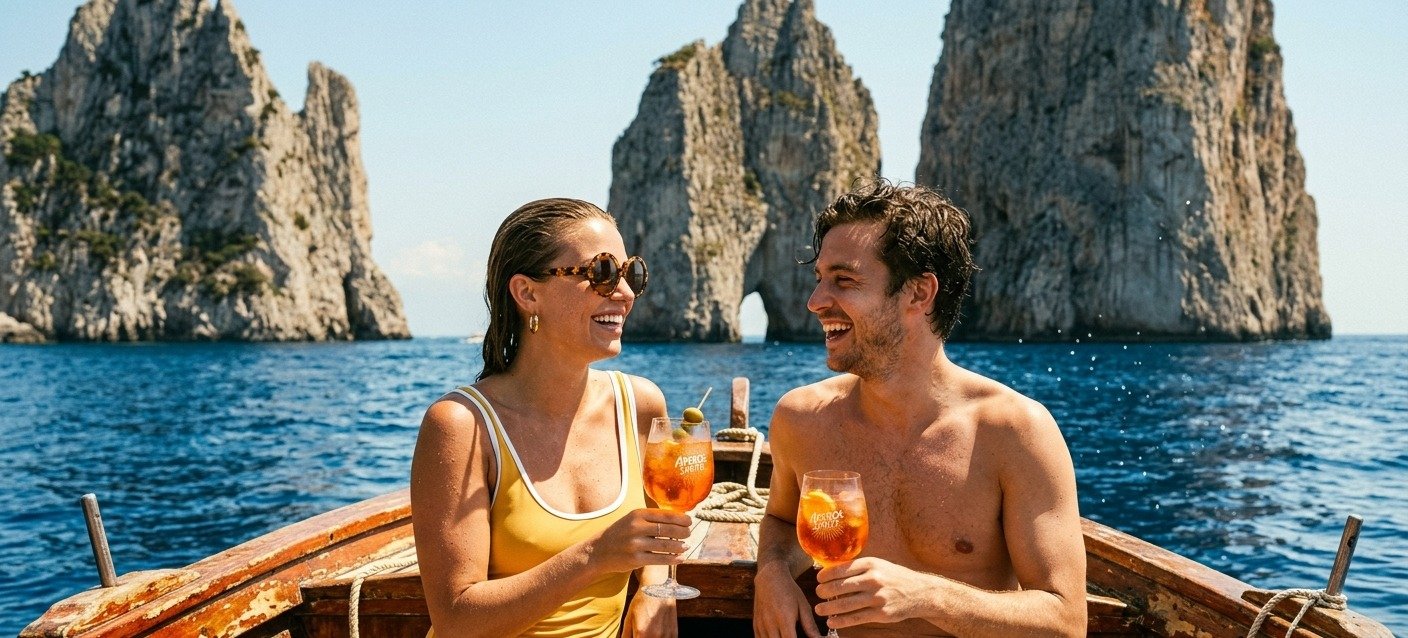
Capri’s oldest romantic ritual is passing under the arch of the Faraglione di Mezzo, the middle rock, and kissing as you go through — tradition says it brings luck. Boats leave from Marina Grande, shared tour or private gozzo with skipper; a circuit of the island takes about two hours (the Grotta Azzurra is a separate rowing-boat entry and no place to photograph a couple). For a proposal we brief the skipper, put you at the bow and ask for the arch on the second pass. Morning sea is flatter; afternoon light is warmer but the swell builds.
Best time: 09:00–11:00 for calm water; 17:00 from June to August for colour on the rocks. Photographer’s tip: wide lens, low at the bow, arch behind you; ask the skipper to cut the engine under the rock.
Villa Comunale terrace (Sorrento)
Sorrento stands on a cliff facing north across the Gulf of Naples; the Villa Comunale terrace, beside the Chiesa di San Francesco, is its balcony. From late spring to early September the sun sets into the sea toward Ischia with Vesuvius on your right; in the shoulder months it drops behind the headland to the west and you get afterglow, not a sun on the water. The terrace is public, free and full at sunset — propose here if you accept an audience, or come at 06:30, when the gardens are empty and the bay is glassy. The cloister next door hosts weddings; ask before shooting inside.
Best time: sunrise for privacy; the last 30 minutes before sunset, May–August. Photographer’s tip: the railing corner nearest the church puts Vesuvius over the couple’s shoulder; expose a little brighter into the light.
Marina Grande (Sorrento)
Not the ferry port — that is Marina Piccola — but the old fishing village under the western cliff, reached through the ancient gate and the steps of Via Marina Grande, fifteen minutes from Piazza Tasso. Pastel houses, boats pulled onto the sand, nets drying, restaurants on stilts over the water: the most Italian frame in Sorrento. The bay faces north-west, so summer evening light runs straight along the beach, and blue hour — restaurant lamps on, the last boats coming in — is where we usually end a session.
Best time: 18:30 until 45 minutes after sunset, June–September; early morning for empty sand. Photographer’s tip: start at the far end of the beach, village behind the couple, then move to the wet sand for reflections.
Lemon groves (Sorrento peninsula)
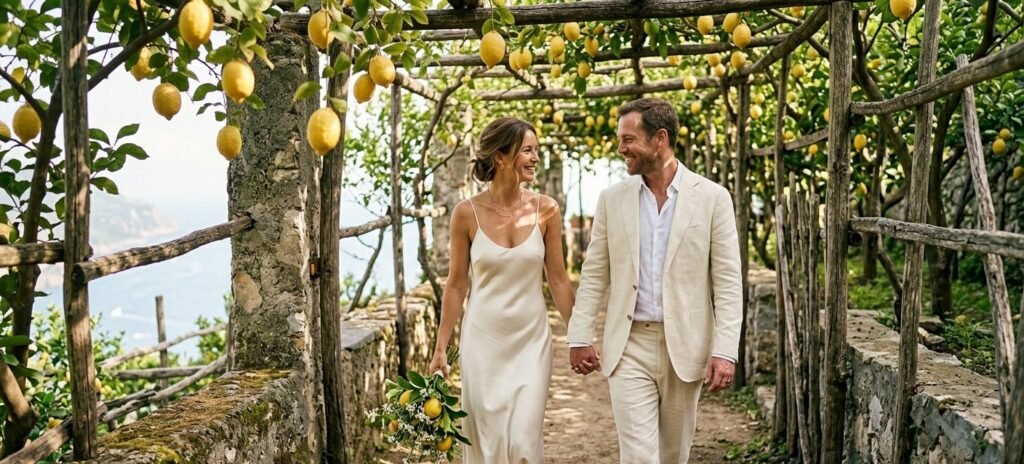
The Sorrento lemon grows under pergolas of chestnut poles roofed with straw mats, the pagliarelle, which turn the grove into a room of dappled light — the one place on this coast where 11:00 in July is a good time to shoot. The groves are working farms: several around Sorrento, Sant’Agnello and Massa Lubrense offer visits, and a session is arranged with the owner in advance, never walked into. Blossom comes in spring and fruit hangs most of the year, thickest from late winter to early summer. Dress in white, cream and pale yellow, with one strong colour.
Best time: late morning to mid-afternoon, April–June, when flowers and fruit overlap. Photographer’s tip: stand the couple under a gap in the mats so one beam of sun falls on them; the rest drops to shade.
Bagni della Regina Giovanna (Capo di Sorrento)
A natural sea pool ringed by rock, open to the gulf through a narrow gap, with the ruins of a Roman villa on the headland above: Sorrento’s wildest spot, and free. Take the bus or walk 35–40 minutes west to Capo di Sorrento, then follow the path down for ten to fifteen minutes; the last stretch is uneven, so trainers, not sandals. The headland faces west and north, so it keeps the sun until sunset in summer and the ruins glow at golden hour. July weekends are busy from midday; by 18:30 most people have gone.
Best time: the last 90 minutes before sunset, May–September, on a weekday. Photographer’s tip: from the ruins above, a long lens looks straight down into the pool — couple on the far rock, sea gap behind, no horizon.
Massa Lubrense, Nerano and Punta Campanella
West of Sorrento the peninsula narrows into Massa Lubrense, villages with Capri parked in the sea in front of them. Termini’s small square looks straight at the island, and a marked path from there — about an hour each way, no shade — reaches the tower at Punta Campanella, the tip of the peninsula, with the Faraglioni a few kilometres across the water. Below, Nerano and Marina del Cantone are a bay of pebbles and restaurants; the hour-long trail from Nerano to the protected Baia di Ieranto ends on a beach facing the Faraglioni. Come by car or SITA bus; bring water and shoes.
Best time: golden hour from late September to March at Punta Campanella, when the sun sets close to Capri; Ieranto in the morning. Photographer’s tip: the Capri skyline without the Capri crowds — dinner in Nerano is the natural cover story.
How a surprise proposal works here with us
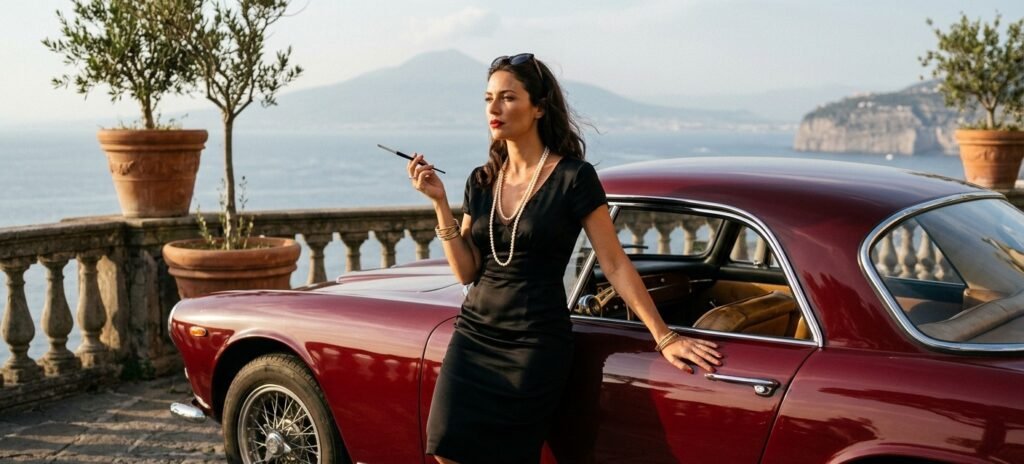
We scout the exact spot the day before: on Capri, the first Pizzolungo steps at Tragara or the bow of a gozzo under the arch; in Sorrento, the church-side corner of the Villa Comunale at 06:30 or the rocks at Regina Giovanna at golden hour. You give your partner a cover story that fits — a sunrise walk before the ferries, an aperitivo in the Piazzetta after “one last viewpoint”, a boat tour with a skipper who is in on it.
You get a WhatsApp pin and we agree a signal. We are already there, 20–40 m away with a long lens. You ask, they say yes, and only then do we walk over; the next 45–60 minutes are a proper portrait session there and nearby, and the gallery arrives within 24 hours with the key frame edited the same day. Details are on the surprise proposal experience page; the step-by-step is in our guide to planning a surprise proposal in Italy.
On Capri the problem is never the light but the ferry timetable: the couples who sleep on the island get the empty belvedere.
Practical notes
- Getting there: Rome–Naples by high-speed train takes about 1h10; hydrofoils to Capri run from Naples (about 50 minutes) and Sorrento (20–25 minutes). Sorrento is on the Circumvesuviana line; ferries link Positano and Amalfi in season.
- Crowds: day-trippers reach Capri around 10:00 and leave by 17:00–18:00; Tragara, the Piazzetta and the gardens are empty before 08:00.
- Seasons: late April–June and September–October are best; July–August is hot, hazy and full; November–March many Capri hotels close and ferries thin out. Month by month: the best time to propose in Italy.
- Tickets: Giardini di Augusto and Villa San Michele are ticketed; the San Francesco cloister and lemon groves need prior arrangement; Via Krupp is often closed. Check the current rules before you go.
- Weather: wind and swell cancel boats and close the Grotta Azzurra; a strong libeccio can stop ferries. Tragara or the Villa Comunale is the fallback; in rain we reschedule free or shoot the moody version.
- What to bring: flat shoes for Via Mulo, Punta Campanella and the Regina Giovanna descent; a layer for the 06:00 ferry; a change for the boat. Palette and outfits: our guide to what to wear.
Frequently asked questions
Do I need a permit to propose on Capri or in Sorrento?
Not for the public viewpoints: Belvedere di Tragara, Marina Piccola, the Villa Comunale terrace, Marina Grande, Bagni della Regina Giovanna and Punta Campanella are open ground, and a discreet proposal with one photographer needs nothing. Ticketed sites such as the Giardini di Augusto and Villa San Michele require an entry ticket and, for a full session, prior agreement with the venue; lemon groves and the San Francesco cloister are private. Check the current rules before you go.
Is sunrise or sunset better for photos of the Faraglioni?
Sunrise, if you are on land. Belvedere di Tragara faces south-east, so the rocks take side-light from about 06:30 in summer and the terrace is empty; by late afternoon the sun drops behind Monte Solaro before the official sunset. For warm evening light on the rocks, go by boat around 17:00 from June to August, when the sea-level angle keeps the sun on them for longer.
How much does a proposal photographer cost in Capri or Sorrento?
Capri and Sorrento are quoted individually, with travel included in the quote. As a reference, our surprise proposal package in Rome is 90 minutes from €490: discreet positioning, the yes moment, then a portrait session, with the key frame edited within hours and 20–80 photos delivered within 24 hours. Sunrise and golden-hour slots go first, so book four to six weeks ahead in peak season.
Can you photograph a proposal on a boat around the Faraglioni?
Yes, and it is one of our favourite set-ups. We brief the skipper in advance, place you at the bow and ask for the arch of the Faraglione di Mezzo on the second pass, engine cut. A morning departure from Marina Grande gives the calmest water; a private gozzo is better than a shared tour because you control the timing. If the sea is rough, we move the proposal to Tragara.
Which is better for a proposal, Capri or Sorrento?
Capri for drama: the Faraglioni, the boat, the belvederes — but you should sleep on the island to get them empty. Sorrento for logistics and the Vesuvius sunset from the Villa Comunale, with the Massa Lubrense peninsula and the Regina Giovanna sea pool close by. Many couples do both: the hydrofoil takes 20–25 minutes, and we can photograph a Capri proposal in the morning and a Sorrento session at sunset.
amalfi coast · capri · engagement photoshoot · photo spots · proposal · sorrento
Planning a proposal or a couples shoot in Italy? Let us frame it.
Tell us the city and the date. We reply within a few hours with availability, the best light window and a quote.